
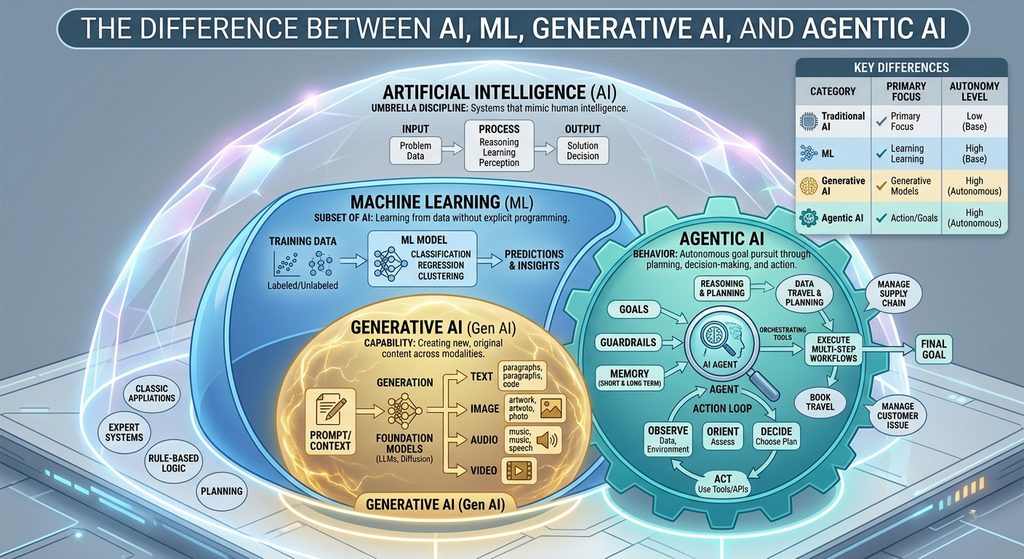
Executive Summary: As artificial intelligence continues to evolve at a breakneck pace, buzzwords like Machine Learning, Generative AI, and Agentic AI are frequently conflated. While they are deeply interconnected, each represents a distinct paradigm, maturity level, and operational capabilities. Understanding their differences is key to navigating modern technology landscapes.
The Matryoshka Doll: A Hierarchical View
To understand how these concepts relate, visualize a set of nested Russian nesting dolls (Matryoshka dolls). At the outermost level lies Artificial Intelligence (AI), the broad umbrella discipline. Inside it sits Machine Learning (ML), a core method to achieve AI. Deep inside ML is Generative AI (GenAI), a specialized model type for content creation. Finally, emerging across and utilizing these layers is Agentic AI, which shifts the paradigm from passive generation to active, goal-driven autonomy.
Deep Dive into the Four Pillars
1. Artificial Intelligence (AI) — The Umbrella Discipline
- Definition: The broad field of computer science dedicated to creating systems capable of performing tasks that typically require human intelligence—such as visual perception, speech recognition, decision-making, and language translation.
- Core Focus: Reasoning, logic, learning, and automation.
- How It Works: AI includes both hard-coded rule systems (like expert decision trees) and modern learning-based models.
- Classic Example: IBM’s Deep Blue beating Garry Kasparov at chess using hard-coded tree search logic and positional evaluation heuristics.
2. Machine Learning (ML) — The Engine
- Definition: A subset of AI focused on building algorithms that automatically learn patterns from data and improve their performance over time without being explicitly programmed for every scenario.
- Core Focus: Pattern detection, classification, regression, and statistical prediction.
- How It Works: Models process large amounts of training data (labeled or unlabeled) to find statistical correlations and generalize rules for unseen data.
- Classic Example: Email spam filters, fraud detection on credit cards, and recommendation engines on Netflix or Spotify.
3. Generative AI (Gen AI) — The Creator
- Definition: A branch of Machine Learning (specifically deep learning utilizing Transformer architectures and Diffusion models) that focuses on generating brand-new, synthetic content across modalities.
- Core Focus: Content generation, text synthesis, image creation, code writing, and media editing.
- How It Works: Trained on massive web-scale datasets to predict the most likely next token, pixel, or audio frequency given a prompt or context.
- Classic Example: ChatGPT generating an essay, Midjourney rendering digital artwork, or GitHub Copilot suggesting lines of code.
4. Agentic AI — The Executor
- Classic Example: An AI assistant told: “Plan and book a 4-day business trip to Chicago under $1,200.” The agent searches flights, evaluates schedules against your calendar, queries hotel APIs, drafts itinerary emails, and requests payment approval.
- Definition: An emerging paradigm of AI designed to operate with high autonomy. Instead of just answering a prompt, Agentic AI pursues open-ended goals by breaking them down into tasks, reasoning, using external tools/APIs, and self-correcting along the way.
- Core Focus: Goal-oriented autonomy, multi-step orchestration, decision-making loops (OODA: Observe-Orient-Decide-Act), memory, and tool integration.
- How It Works: Combines Large Language Models (LLMs) for reasoning with short/long-term memory modules, web search capabilities, code execution environments, and API integrations to execute workflows independently.
3. Comparison Matrix
| Feature / Dimension | Traditional AI | Machine Learning | Generative AI | Agentic AI |
| Primary Goal | Execute pre-defined logic | Find patterns & predict | Create new content | Accomplish complex goals |
| User Interaction | Input structured data | Provide training datasets | Single prompt / turn-based | High-level goal directive |
| Autonomy Level | Low (Rule-bound) | Low (Static predictions) | Medium (Prompt-dependent) | High (Self-directed action) |
| Key Mechanism | Symbol manipulation, rules | Statistical inference | Probabilistic token generation | Reasoning, Planning & Tool Use |
| Typical Output | True/False, rigid decision | Score, category, trend | Text, image, audio, code | Completed workflow / Task action |
4. The Shift: From “Answering” to “Acting”
The fundamental difference between Generative AI and Agentic AI lies in the human-in-the-loop dynamic and the control loop:
[ Generative AI Flow]
User Prompt ──► LLM ──► Text / Image Output (Stops here)

[ Agentic AI Flow]
User Goal ──► Planning & Decomposition ──► Tool Use / API Calls ──► Observe Results ──► Self-Correction ──► Goal Met
- Generative AI waits for a user prompt, generates text or media based on its context window, and stops. If you ask it to “write a marketing strategy,” it produces a document.
- Agentic AI takes that strategy and executes it:
- Creates draft assets using GenAI models.
- Integrates with Hubspot / Mailchimp via API to schedule campaigns.
- Monitors click-through metrics via analytics integrations.
- Adjusts future email timing based on performance data without requiring constant user intervention.
5. Summary Key Takeaways
- AI is the vision of intelligent machines.
- ML is the mathematical foundation that allows systems to learn from experience.
- Generative AI gives machines a voice and creative output capability.
- Agentic AI gives machines agency—the hands, decision-making capabilities, and autonomy to interact with the digital and physical world.