
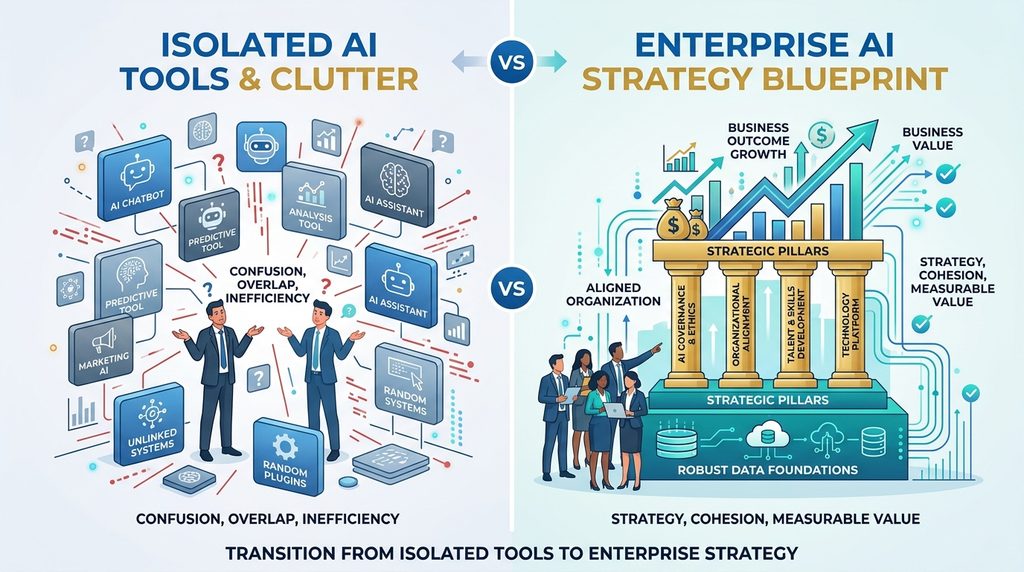
Artificial intelligence has become the new corporate gold rush. Vendors promise transformation, analysts hype trillion‑dollar productivity gains, and executives feel pressure to “do something with AI” before competitors outpace them. The result? Many enterprises rush to buy AI tools—chatbots, copilots, automation platforms, analytics engines—without a clear strategy for how these technologies will actually create value.
That’s the fastest path to wasted budget, fragmented systems, and frustrated teams. The truth is simple: AI tools don’t create impact. AI strategy does.
Below is a structured, practical breakdown of why every enterprise needs a coherent AI strategy before investing in AI tools—and what that strategy should include.
🧭 The Core Takeaway
An enterprise AI strategy aligns technology with business outcomes, data readiness, governance, and long‑term scalability. Without it, AI investments become isolated experiments instead of enterprise‑wide accelerators.
🚨 The Risks of Buying AI Tools Without a Strategy
- Tool sprawl and redundancy — Teams buy overlapping tools that solve similar problems, leading to confusion, inconsistent workflows, and unnecessary spending.
- No measurable ROI — Without defined success metrics, AI becomes a cost center instead of a value driver.
- Data chaos — AI tools depend on clean, accessible, governed data. Most enterprises don’t have it. Tools purchased prematurely end up underused or abandoned.
- Security and compliance gaps — AI introduces new risks: model hallucinations, data leakage, regulatory exposure. Tools alone don’t solve these.
- Cultural resistance — Employees won’t adopt AI if they don’t understand how it fits into their work or fear it threatens their roles.
- Misaligned priorities — AI gets deployed where it’s easiest, not where it matters most.
Buying AI tools without strategy is like buying gym equipment without a fitness plan—you end up with expensive clutter.
🧩 What an Effective Enterprise AI Strategy Includes
1. Clear Business Objectives
AI should solve real problems:
- Reduce operational costs
- Improve customer experience
- Accelerate product development
- Strengthen decision‑making
- Enhance employee productivity
If you can’t tie an AI initiative to a business KPI, it’s not ready for investment.
2. Data Readiness Assessment
AI is only as good as the data feeding it. Enterprises must evaluate:
- Data quality
- Data accessibility
- Data governance
- Integration across systems
A strategy ensures you fix foundational issues before layering AI on top.
3. Enterprise Architecture Alignment
AI tools must fit into:
- Existing workflows
- Security frameworks
- Cloud infrastructure
- Integration patterns
This prevents siloed deployments and ensures scalability.
4. Governance, Risk, and Compliance
A mature AI strategy defines:
- Responsible AI principles
- Model monitoring and auditing
- Human‑in‑the‑loop controls
- Regulatory compliance (GDPR, HIPAA, etc.)
Governance isn’t optional—it’s the backbone of enterprise AI.
5. Change Management and Workforce Enablement
AI adoption requires:
- Training programs
- New operating models
- Updated job roles
- Clear communication
People—not tools—ultimately determine whether AI succeeds.
6. Prioritization Framework
Not every AI idea deserves funding. A strategy helps you rank initiatives by:
- Business impact
- Feasibility
- Risk
- Time to value
This ensures resources go to the highest‑value opportunities.
7. Long‑Term Roadmap
AI isn’t a one‑off purchase. It’s a multi‑year transformation. A roadmap defines:
- Short‑term pilots
- Mid‑term scaling
- Long‑term automation and agentic systems
This keeps the enterprise focused and aligned.
🏢 Why Enterprises With AI Strategies Win
Enterprises that build strategy first consistently outperform those that buy tools first. They achieve:
- Higher ROI
- Faster adoption
- Lower risk
- Better customer outcomes
- Stronger competitive advantage
They treat AI not as a gadget, but as a capability.
🚀 The Bottom Line
AI tools are powerful—but only when deployed with intention. A well‑defined AI strategy ensures your enterprise invests in the right tools, solves the right problems, and builds the right foundation for long‑term success.
AI is not a shopping decision. It’s a strategic one.